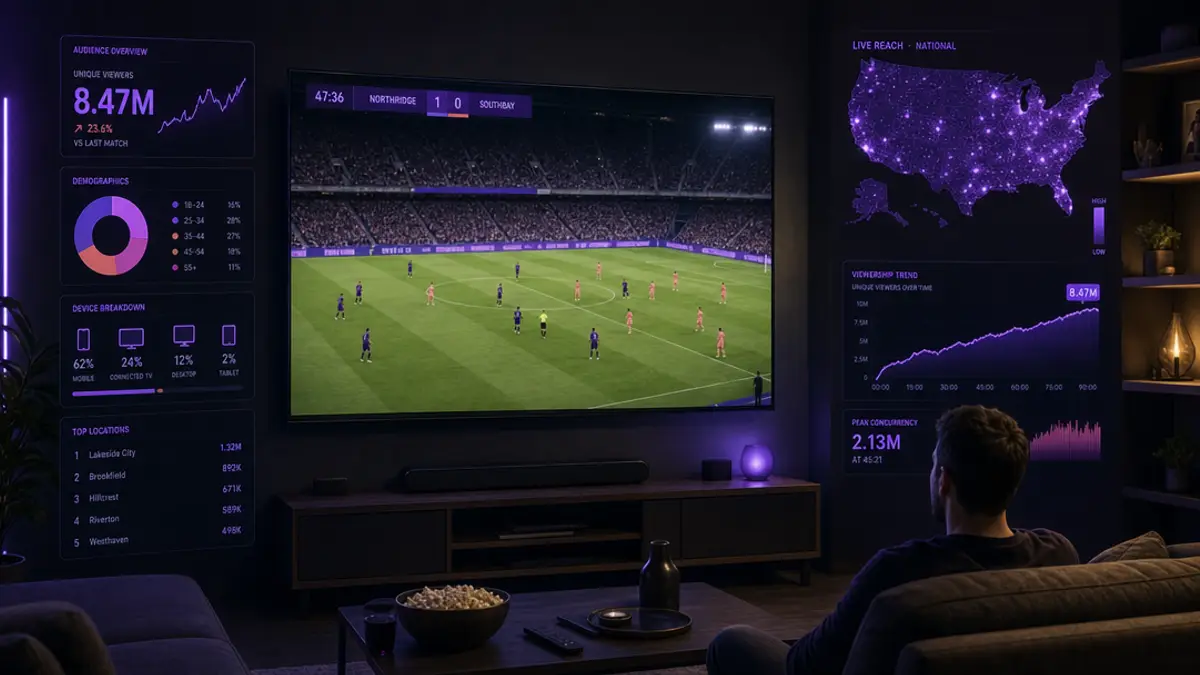
Live sports is the last reliable mass audience on television, and a growing share of it watches away from home. Sports drew nearly 30% of all ad-supported TV viewing among U.S. adults ages 25 to 54 in the fourth quarter of 2025, and out-of-home viewing can add as much as 68% to the audience for a single game. This guide covers what live sports advertising is, why it commands budgets, what it costs, who is watching and where, how it is measured, and how brands buy it.
What is live sports advertising?
Live sports advertising places ads in and around live sporting broadcasts: the games, matches, and events that still gather a large audience at the same moment. It spans linear TV, streaming (CTV), and in-venue advertising on the screens in bars and restaurants. What unites them is the programming. Live sports is watched live, with the ads, by a crowd that chose to show up for the event.
That makes it different from most of what is left on television. As home viewing fragments across streaming apps and on-demand libraries, live sports is the format that still delivers appointment viewing at scale.
Why does live sports command advertiser attention?
Because attention and spend both concentrate there. Sports accounted for 29.2% of all ad-supported TV viewing among adults 25 to 54 in the fourth quarter of 2025, which Nielsen framed as nearly 30% of the ad-supported marketplace. (Nielsen)
Football dominates what mass reach remains: the NFL made up 93 of the top 100 most-watched U.S. broadcasts in 2023. (EMARKETER, citing Nielsen) The spend follows the eyeballs. Live sports programming accounted for nearly 40% of U.S. national TV ad spend in the fourth quarters of both 2022 and 2023. (EMARKETER) The pull is strong enough to move the whole market: in the fourth quarter of 2025, ad-supported TV rose to 74.2% of all TV viewing, the highest point of the year, driven mainly by football. (Nielsen)
Live sports also holds attention in a way on-demand content does not. A single Thanksgiving Day NFL game in November 2025 generated 11.7 billion viewing minutes, nearly matching what Netflix’s biggest title produced across the entire month. (Nielsen) And the ads perform: ads in streaming-exclusive NFL games were 66% more effective than the cable and broadcast average during the 2024 to 2025 season (EMARKETER), and ad ROI on the Super Bowl nearly doubled from $2.70 in 2020 to $5.20 in 2023. (EMARKETER)
How big is the live sports advertising market?
It is a roughly $20 billion U.S. converged TV marketplace, and growing. EMARKETER describes U.S. sports converged TV advertising as a $20 billion market and projects combined linear and streaming sports TV ad spending to grow by $5.3 billion between 2026 and 2030. (EMARKETER)
The digital side is pulling that growth. Connected TV ad spend rose 16% to $23.6 billion in 2024 and is projected to reach $26.6 billion in 2025, with the industry crediting live events and sports for part of the rebound. (IAB) An estimated 105.3 million Americans, about 30.8% of the population, were expected to watch live sports digitally in 2024. (EMARKETER)
Why is buying live sports getting more complicated?
Because the rights are scattering across services. Sports program offerings on the top five streaming platforms increased 52% year over year in the first quarter of 2026. (EMARKETER) For a buyer, that means the audience for a single sport now lives across linear networks and multiple streaming apps, and a plan built for one screen misses the rest.
This is the gap in-venue advertising fills. The same fans who scatter across services at home gather in the same rooms to watch, on the same screens, at the same time.
How much does live sports advertising cost?
It is priced on a CPM basis, the cost to reach a thousand viewers, and the rate depends on the channel. Recent upfront CPM averages ran about $43.50 for broadcast primetime, $27.25 for streaming, and $19.35 for cable primetime. (MediaPost, citing Media Dynamics)
Two caveats matter. First, live sports inventory usually prices above these broad channel averages, and the sharpest sports rates are negotiated privately in upfront and scatter markets, so a clean public sports CPM table does not exist. Second, in-venue advertising is the efficiency play: it delivers live programming inventory at a significantly lower CPM than streaming CTV alternatives, while reaching a crowd those channels do not measure.
Who watches live sports, and where?
A large and growing share watches out-of-home, and the audience is broader than the old stereotype. Nielsen reports that out-of-home viewing can add as much as 68% to the audience for sports programming, with the lift varying by event.
The audience is also more diverse and more affluent than many media plans assume. Women now make up 42% of fans of men’s sports and 47% of fans of women’s sports, both up since 2022. (Nielsen) The U.S. soccer fan base skews young, diverse, and high-earning: 76% are Millennials or Gen Z and 34% have a household income above $100,000. (Nielsen) And the loyalty pays back: Hispanic sports fans are 39% more likely to recommend a company and 37% more likely to feel loyal to a brand that sponsors a sport they follow. (Nielsen)
What about the out-of-home audience specifically?
It is now fully measured, and it gathers in venues. Nielsen expanded its national out-of-home panel from 65% to 100% of U.S. TV households in 2024, measuring viewing in places like airports, hotels, bars, and restaurants. (Nielsen) Out-of-home sports viewing is not anecdotal; it is part of a measurement framework Nielsen has run for nearly a decade.
That out-of-home crowd is exactly who in-venue advertising reaches. Taiv’s network reaches 30 million monthly customers across more than 6,000 venues and delivers over 5.2 billion monthly impressions. The setting drives attention: in-venue viewers show 45% greater ad receptiveness than at-home TV viewers, and the average visit lasts 82 minutes, so a campaign reaches the same engaged people repeatedly in one sitting. For more on the channel, read what in-venue advertising is and how it compares to DOOH.
When should brands buy live sports?
When the audience peaks, which is increasingly the back half of the year. Ad-supported TV viewing climbed to its 2025 high in the fourth quarter, up 9% quarter over quarter, with football the main driver. (Nielsen) The return of football in the fall reliably lifts total TV usage rather than merely reshuffling it, and live sports concentrates roughly 40% of national TV ad spend into those late-year windows. (EMARKETER) Planning spend to land before those windows captures the spikes instead of chasing them.
How is live sports advertising measured?
Like digital video, not like a billboard. The baseline is verified delivery: proof of play confirms each spot ran. From there, outcome studies connect exposure to results: incrementality and matchback measure the net-new effect against a control group, brand lift tracks awareness and recall, footfall attribution and web lift measure visits, and tune-in lift measures whether exposure drove people to watch. The point is that live sports advertising, including in-venue, reports on the same outcome terms a buyer already uses.
How do brands buy live sports inventory?
Three ways, often together: linear TV for broad household reach, streaming (CTV) for addressable home audiences, and in-venue advertising for the out-of-home crowd the other two miss. Each can be bought as a direct insertion order or programmatically.
In-venue specifically can be targeted the way any digital video campaign is, by venue type, by sport or live event, by market and daypart, and by season. The strategy for reaching fans during the specific games that matter is Sports Parting: targeting live sports advertising to specific games, leagues, teams, and events across a nationwide network of venue screens. For a brand already running linear and CTV, in-venue adds incremental reach during the exact moments fans gather.
Live sports is where television still gathers a crowd, and the out-of-home share of that crowd is large, measured, and reachable. To plan a campaign across Taiv’s venue network, explore advertising with Taiv, or browse the glossary for any term above.
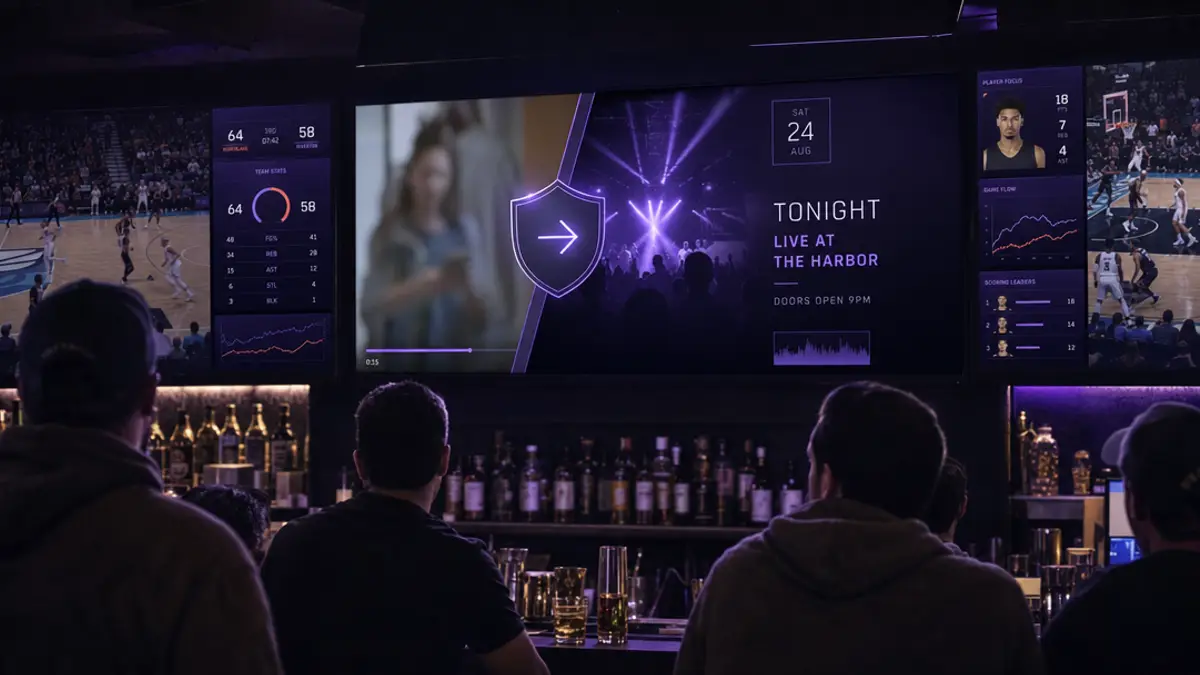
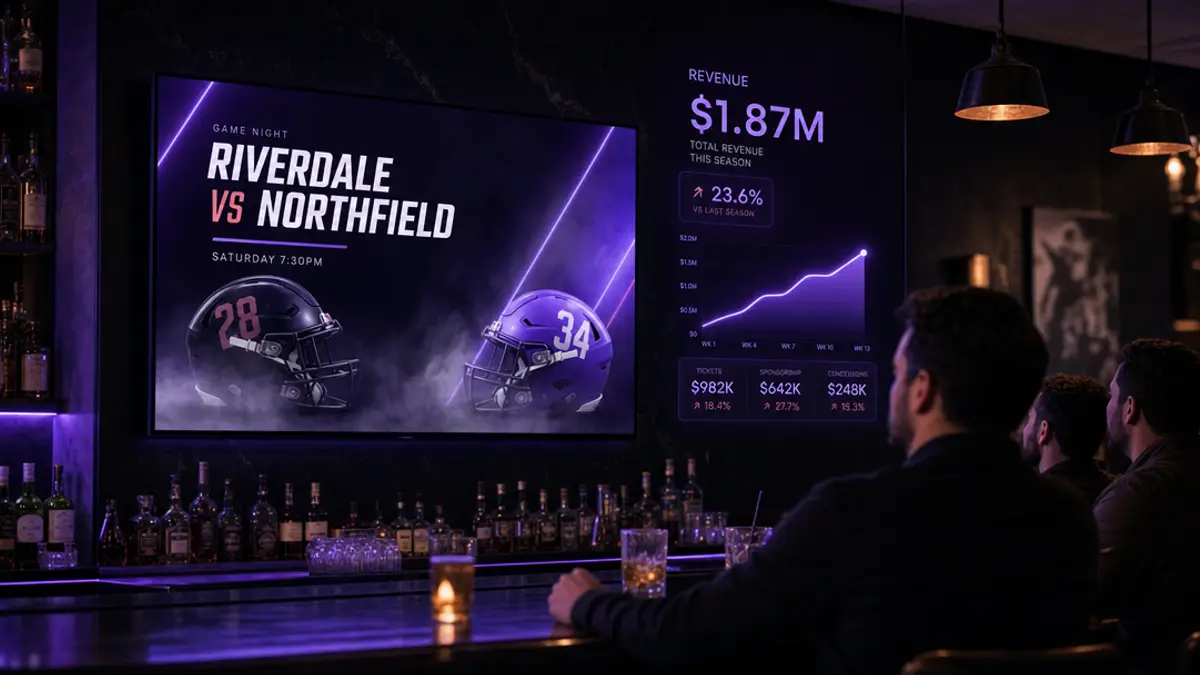
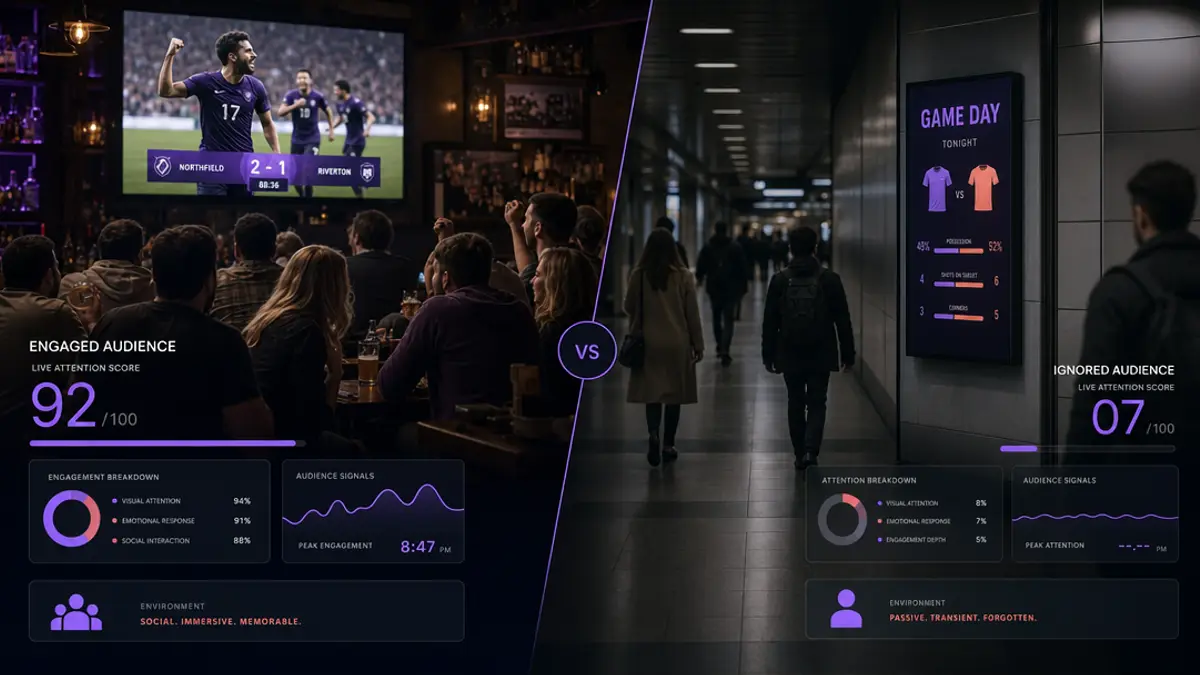
Two sides of the same screen.
Venues take control of their TVs, run their own promos, and earn from every break. Brands reach real crowds during the games that matter. Whichever side you are on, Taiv is how the screen pays off.